Croatia
56 594 sq km (21 851 sq mi)
about 4.15 mil people
Zagreb
Croatian
Christians 91%, irreligious 5%,Islam 1%,other 3%
Euro (EUR)
GMT (London) + 1 hour; CET + 0 hours
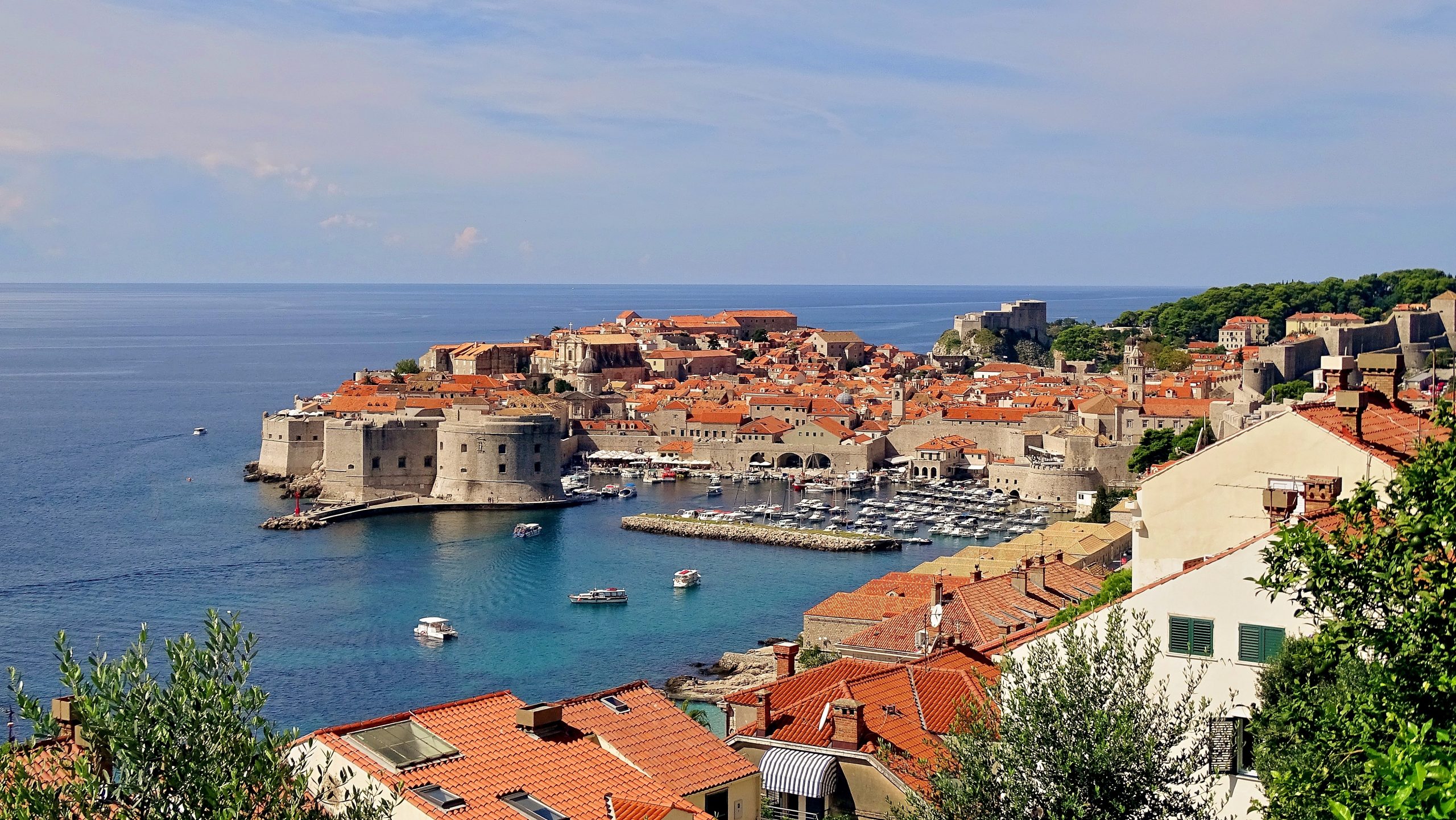
Croatia offers a rich tapestry of history and culture, reflected in its beautifully preserved towns and cities. Each area has its own character: the coastal towns boast stunning architecture shaped by centuries of Mediterranean influence, while the continental regions showcase a more Central European style.
Dubrovnik, known as the “Pearl of the Adriatic,” is a highlight of the coast, with its impressive city walls and historic old town. Zagreb, the capital, is a vibrant modern city of around one million residents, blending contemporary life with a relaxed, friendly atmosphere.
In eastern Croatia, Slavonia is notable for its regional capital, Osijek, and the historically significant city of Vukovar, a place marked by its recent past and resilient spirit. The countryside here is dotted with vineyards and traditional wine cellars, many of which welcome visitors for tours and tastings, offering a taste of local culture and hospitality.
The Croats settled in the region in the early 7th century, forming two principalities: Croatia and Pannonia. Around 850, the establishment of the Trpimirović dynasty strengthened the Dalmatian Croat Duchy. By 925, the duchies united into the Kingdom of Croatia under King Tomislav. This independent kingdom lasted until 1102, when, after a series of dynastic struggles, Croatia entered a personal union with Hungary, with the Hungarian king ruling both countries.
In 1526, after the Battle of Mohács where Hungary suffered a catastrophic defeat against the Ottoman Turks, Croatia ended its union with Hungary. The Croatian parliament (Sabor) voted to form a new personal union with the Habsburg Monarchy. Croatia remained an autonomous kingdom within the Habsburg state (and later Austria-Hungary) until the empire dissolved following World War I.
In 1918, the short-lived State of Slovenes, Croats, and Serbs, carved from southern Slavic territories of Austria-Hungary, joined the Kingdom of Serbia to form the Kingdom of Serbs, Croats, and Slovenes, later renamed Yugoslavia in 1929. This unitarist state erased historical borders, prompting strong demands for Croatian autonomy. In 1939, just before World War II, Croatia gained broad autonomy within Yugoslavia as the Banovina of Croatia.
During World War II, Germany and Italy invaded Yugoslavia in 1941, dissolving the state, annexing territories, and installing puppet governments. In Croatia, the Independent State of Croatia was controlled by the pro-Nazi Ustasha regime. In response, a strong resistance movement emerged, led by communist Josip Broz “Tito,” who gained widespread support.
After the war, Tito became president of the newly formed communist Yugoslavia, ruling with a strong hand while promoting “Brotherhood and Unity.” Although politically repressive, Yugoslavia was not part of the Warsaw Pact after 1948, making it the most open socialist country in Europe, with a higher standard of living and more civil liberties than its Eastern Bloc neighbors.
Tito’s death in 1980 led to political instability, rising nationalist movements, and economic recession. In 1991, Croatia and Slovenia declared independence, sparking war in Croatia and later in Bosnia and Herzegovina. After four years of conflict, Croatia achieved a decisive victory in Operation Storm in 1995, an event now commemorated as Thanksgiving Day on August 5.
Following accelerated economic growth in the late 1990s and early 2000s, Croatia joined NATO in 2009 and the European Union in 2013. Today, Croatia is a liberal democracy with a free-market economy and a well-developed welfare system.
Croatian cuisine reflects the country’s diverse regions and rich culinary heritage. Start your journey with aperitifs such as the world-famous Maraschino of Zadar, then sample regional specialties like Pag cheese, Slavonian ham, and kulenova seka. Along the coast, enjoy fresh oysters and mussels from Ston, grilled fish, and salted anchovies, while the Neretva Valley offers delicacies such as eels and frogs. Other iconic dishes include turkey with mlinci, pašticada from Split, and a variety of desserts, including puddings, Kotonjata, kroštule, and fritule.
Food lovers can experience Croatian cuisine at numerous festivals and tastings held throughout the year. Explore the scenic wine routes in Slavonia, Dalmatia, and Central Croatia, and savor the region’s specialties: white truffles from Istria, sheep’s milk cheese from Pag, and the golden honey of Hvar. Croatian gastronomy promises a feast for the senses, offering flavors that are as diverse as the country’s landscapes.
Croatia became a member of the European Union on 1 July 2013 and joined the Schengen Area on 1 January 2023. As a result, immigration controls for travellers from other Schengen countries have been lifted, and Croatia now fully follows the Schengen visa rules.
Citizens of the EU, EEA, Switzerland, Andorra, Monaco, San Marino, and Vatican City can enter Croatia visa-free with either a passport or a national identity card.
Foreign nationals of the following countries/territories can enter Croatia visa-free for up to 90 days within a 180-day period with a valid passport: Albania, Antigua and Barbuda, Argentina, Australia, Bahamas, Barbados, Bosnia and Herzegovina, Brazil, Brunei, Canada, Chile, Costa Rica, El Salvador, Guatemala, Honduras, Israel, Japan, North Macedonia, Malaysia, Mauritius, Mexico, Montenegro, New Zealand, Nicaragua, Panama, Paraguay, Saint Kitts and Nevis, Serbia, Seychelles, Singapore, South Korea, Taiwan, Turkey, United States, Uruguay, Venezuela, and holders of British National (Overseas), Hong Kong SAR, or Macau SAR passports.
Holders of valid refugee travel documents or stateless person documents issued by an EU member state, Andorra, Canada, Iceland, Japan, Liechtenstein, Monaco, Norway, San Marino, Switzerland, the United States, or the Vatican City may also enter Croatia visa-free for up to 90 days.
Holders of residence permits or visas (C or D) issued by any Schengen country are exempt from the Croatian visa requirement.
All other travellers must obtain a visa in advance from a Croatian embassy or consulate. The application fee for a short-stay Croatian visa is €35.
Further details on visa requirements, exemptions, and application procedures are available on the Croatian Ministry of Foreign and European Affairs website.
Credits: Croatia by Wikitravel and Croatia Tourist Board